Who Are We

What We Do | Uniqueness | What We Offer | Team | History | Annual Report


What We Do


Vision and missionBright Hope World works mainly through key Christians and indigenous churches who understand their community and who can deliver holistic, unconditional compassion to all people, regardless of their gender, religion, race or ethnicity.

In order to fulfil our mission, Bright Hope World focuses on building partnerships with local people and churches that have a compelling vision to develop their communities so that relief can be delivered in the short and medium term while training, job creation and sustainable development can be implemented.

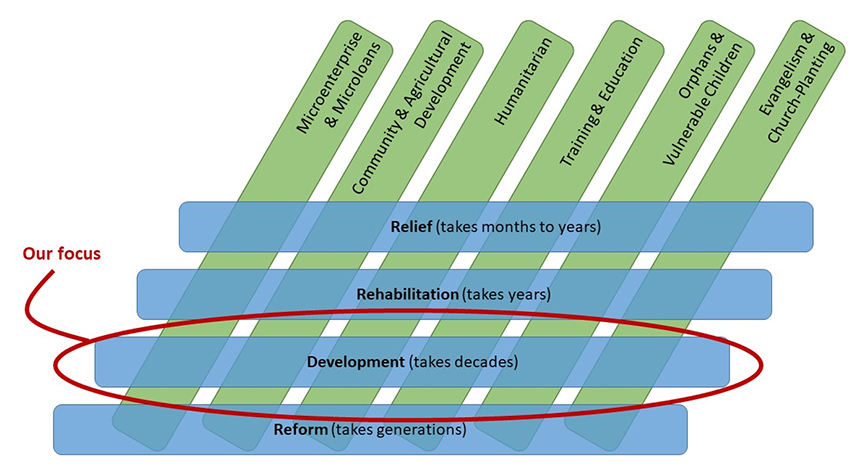
Our aim is to see lives changed and the poor empowered to be independent by concentrating on three key areas:


  1. Relief in Crisis


    Children in Lira, UgandaOften communities require short term relief to avert disaster before longer term solutions can be found. This could be a natural disaster (an earthquake or tsunami), or more likely for our partners, a broader crisis issue such as poverty, a health pandemic like HIV / AIDS or an oppressed minority group.

    At the local level this may result in the provision of food supplements, resource support for medical clinics and personnel, sponsoring of children to attend school, intervening in the lives of suffering families or assisting an individual with specialised help.


  2. Christian Community and Leadership


    Children learn in a school in Mathare, KenyaWe strongly believe that community transformation requires holistic intervention. This requires responding appropriately to the economic, educational, health and spiritual aspects of life.

    We understand that spiritual transformation is the major catalyst for change and are convinced that the local churches are the best agency for delivery of that change. A relationship with Jesus Christ and connection to the local church is the preferred context for sustainable, lifelong transformation. The establishment of churches in areas where there are none is one of our goals.


  3. Sustainable Development


    A sewing school in Lucknow, IndiaIt is vital for individuals and communities in developing countries to be able to stand on their own feet without external support. Although partnership and support may be initiated through crisis, we believe there is an obligation to assist with ongoing independence.

    This is most often delivered by assisting local people to discover the answers that exist in their own communities. This process involves identifying these opportunities, developing relevant strategies to take advantage of these opportunities and assisting in implementation by connection to relevant resources.

    This may involve the establishment of training courses, access to micro-finance loans and/or funding for agriculture or small-scale businesses, support and establishment of community schools or skills training centres, and the establishment of enterprises that create employment.


Everything that Bright Hope World does is within the context of partnership. This is one of the key aspects of our organisation that makes us unique. Click here to find out more about the types of partnership we invest in.


How We're Unique


Vision and missionBright Hope World is committed to five core values that not only drive all thinking and operations, but also make us unique:


  1. We focus on the poorest of the poor


    It is easy for huge needs presented by people living in poverty to overwhelm, so Bright Hope World has committed to focusing our efforts on certain types of partnerships. Overall, we are focused on those who earn less than $US2 per day: the poorest of the poor.

    Beyond this Bright Hope World pursues partnerships that have the potential to break poverty cycles and deliver genuine transformation.


  2. We invest in strategic partnerships


    The core of Bright Hope World's mission is partnership, which is the defining principle of our operations. Partnership is a concept that is, unfortunately, not always implemented in Christian-based poverty relief agencies.

    Partnership is based on the belief that the parties have equal value – before God and in terms of capability. It is a recognition that a local person with a vision for, and commitment to, serving those around them will be far more effective than someone coming in from a foreign culture. It is a belief that local solutions to local problems will tend to be more successful and sustainable than imported concepts that fail to understand the nuances of local conditions, culture and traditions. It is about understanding that the agency's role is to provide accountability, oversight and resources, not to be the source of the 'bright ideas'.

    While this concept is relatively easy to accept at face value, it can easily be eroded in practice. In the absence of genuine humility and appreciation for the vision and giftings that God provides to people around the world, partnership fails.

    Bright Hope World operates by initially building relationships with locals who have a vision to reach their local communities. Through our field staff potential partners are identified and, typically, relationships are slowly built over time, long before any funding is provided.

    This process, which usually takes from eighteen months to three years, ensures that the integrity and reliability of the partner can be assessed, and their performance and commitment evaluated over time. Experience suggests that partnerships established hastily do not succeed in the long term.

    Once a partnership is initiated, our commitment is a long term one. Fast results and returns are not the focus, but rather the ability of the partner to deliver holistic transformation of their local community over a long time period. Bright Hope World will stay involved with the partner until this impact is seen and our support is no longer required, ideally because the project is completely self-sustaining.


  3. We are field-driven


    This value ensures that Bright Hope World maintains a constant focus on the needs of the poor, and does not allow itself to shift its primary focus onto serving the needs of donors. Donors are, of course, critical to the success of our partnerships, but we are unashamedly focused first and foremost on our partners in the field.

    This field focus also gives rise to a number of operational principles within Bright Hope World:

    • The initiative always remains at the field end. The role of Bright Hope World is as an enabler and a point of accountability. Bright Hope World does not look to impose 'great ideas' but rather to resource those that already have the idea and a proven track record, but lack resources.


    • The first question Bright Hope World always asks is, "how will it affect the field?" The primary loyalty and focus must remain on the field, and every decision must be considered in the light of its potential impact on our partners in the field.


    • Money does not buy influence. It is almost a defining principle of western civilisation that whoever has the money has the influence. Bright Hope World seeks to protect partners in the field from this notion. While we certainly welcome large donors, and seek to accommodate the needs and requests of these donors, this is never done at the expense of the needs of the partners in the field.


    • Field visits are tightly controlled. As a general rule, Bright Hope World will only take key leaders and potential leaders on visits to the field, with a Bright Hope World team member present at all times. This is not an issue of trust, but of experience. The potential – and history – of problems arising in the field during field visits is high, as people operating out of their comfort zone, and experiencing strong emotions can easily say or do something which can threaten the partnership or damage the credibility of Bright Hope World or the partner in the field. We also believe that excessive field visits can lead to a growing dependency in the partner on external input.


    • We respect and work within the protocols of local culture and customs. Avoiding a Eurocentric perspective in the field is not a matter of 'political correctness' but rather a core tenet of partnership. Bright Hope World recognises that requiring a local project to embrace western culture or customs is usually counter-productive and unnecessary. Building projects with an inherent understanding of the local culture and customs, and allowing them to operate in accordance with these – except where this would breach a clear biblical principle – results in better outcomes and the avoidance of unnecessary barriers to success.


  4. We emphasise sustainability


    Bright Hope World is focused on partnerships that are self-sustaining, although this is not always possible. Projects which deliver jobs to the poor, or which can restore dignity and self-provision through micro-loans or micro-enterprise are also favoured.


  5. We are committed to a low overhead structure


    This value is focused on ensuring that we operate on a 'lean' basis with overheads tightly constrained. Ultimately this value is about compassion. It is a recognition that every dollar we remove from the Bright Hope World accounts for operating expenses or salaries is a dollar that doesn't go to support the poorest of the poor. Keeping this reality constantly in mind ensures that every expenditure decision is carefully weighed and justified.

    In practice this value means that Bright Hope World spends little on marketing and advertising, and instead relies on the networks of people of influence. It also means that most of our team are volunteers who have 'caught the vision' and want to be a part of the work that God is doing through Bright Hope World. Many of Bright Hope World's volunteers work in other roles and give part of their time, unpaid, to the ministry.

    This approach is often challenging for those who have come from a secular business environment – as many of our team have – and requires a restraint and discipline that is not the norm in the commercial world. Because of this, Bright Hope World workers tend to be highly committed to the vision, and to serving sacrificially, which is a vital witness and sign of integrity to Bright Hope World's donors and partners.


What We Offer


Vision and missionBright Hope World focuses on partnership at every level of our operation. A key reason for our commitment to partnership is a recognition that everyone has something to bring to the table, and we are best to focus where we can offer most value. For this reason we do not try and impose our vision on our partners in the field, but instead gravitate towards those that already have a compelling vision to reach their communities.

It is also for this reason that we encourage people who want to engage in missions to work with us: we are very good at what we do and can help achieve positive outcomes in the developing world more efficiently and effectively than most of those who try to work directly in the field.

There are three key reasons for this:


  1. Our experience


    Cross cultural mission is easy to get wrong. Every people group (and likely every tribe within a people group) has cultural nuances that take time and effort to understand. Failing to fully grasp these issues can cause offence or embarrassment at best, and can completely undermine a partnership (and any future partnerships) at worst. Knowing how best to interact with a people group is an area of expertise for Bright Hope World because we have a team that has built strong relationships with our partners over many years and has learned what works and what doesn’t in different cultural and economic contexts.

    Working through Bright Hope World means that any given project or partnership is given the best chance of success because of the depth and breadth of experience of our team.


  2. Our approach


    Part of Bright Hope World’s way of operating is slow engagement. We don’t rush into a relationship with a partner, but rather take our time to get to know them, and their family and church and support network.

    This ‘due diligence’ ensures that when we do determine a relationship is appropriate for entering into partnership, we can be sure of the integrity and credibility of the people and their vision. This inevitably takes years, but our commitment to partnership demands that we undertake this work carefully, so that we can forge a strong relationship that is enduring and outcomes-focused.


  3. Our organisation


    Bright Hope World is set up exclusively to resource and develop partnerships. We have a team of experts that have extensive experience in working with partners in the field, optimising outcomes and addressing the inevitable issues that arise in any relationship. To reproduce this kind of infrastructure locally would be expensive and ultimately less effective. Because of the number of partnerships we have, we have economies of scale in effect, and can service the partnerships very efficiently.

    This, matched with our value of operating under a low overhead structure, means that we take a maximum of 10% administration from any funds given to us, and we often take nothing. This results in the highest possible level of funding reaching the field, where it is most needed.

    The combined effect of our experience, our approach and our ethos is that Bright Hope World offers considerable value to donors and churches by:

    • Undertaking extensive pre-partnership due diligence to ensure the integrity and credibility of the partner and the project.


    • Selecting, based on experience, those partnerships and projects that have a high potential for success.


    • Avoiding cultural or others barriers to success for a partnership of project.


    • Providing effective and efficient oversight and relationship management with partners to ensure positive ongoing outcomes.


    • Ensuring maximum passage of funds to the field by operating an efficient system for maintaining and overseeing partnerships.


Our Team


New Zealand Head Office Team


Rob Purdue
Executive Chairman

Rob has been involved directly in charitable work among needy people around the world for over 20 years with an interest that precedes that for many years.

He is widely respected for encouraging only highly effective and accountable projects. Rob is regularly in the field maintaining close scrutiny of the work.

Rob has a background in financial planning and risk management. He left a successful national business to help establish Bright Hope. He is married to Heather and has two married children.


Fraser Scott
Executive Director

Fraser has worked with Bright Hope for several years, coming from a legal and management consulting background. Fraser still consults to organisations in the corporate and non-profit sectors part-time.

Having spent time with Bright Hope partnerships in Thailand and India, Fraser has a real passion for micro-enterprise and micro-loans programmes.

Fraser's responsibilities include media and strategy, La Mai coffee and Hope World Partnerships in the USA.

Fraser is married to Debbie (Bright Hope's in-house graphic designer) and has three young boys.


Jarrod Purdue
Income Generation Director

Jarrod trained as a teacher, and after graduation taught maths and physical education in New Zealand schools for three years, but then headed to Africa where he spent a year helping aid and mission groups. Richer for the experience, he moved to London where he worked for 12 months as a teacher and then as a site manager for the next seven years.

Now back in New Zealand with his wife and three children, he is primarily involved with income generation for Bright Hope World through property development.


Heather McLennan
Administration Manager

Heather joined the Bright Hope World team in March 2008 having previously worked in an administration capacity in the medical industry for the last 20 years.

Heather has always had an interest in overseas missions and in July 2007 visited Zambia for two weeks with a team from Riccarton Community Church in association with Bright Hope World. This gave her valuable insight into the work of Bright Hope World and so when the opportunity became available she was very keen to be able to use her skills/abilities to enhance the work of Bright Hope.


Karena George
Office Administrator

Karena joined the Bright Hope World team in May 2010 to assist with administration and accounts duties. She is married to Darryn and they have three children. Prior to taking several years out of the paid workforce to be a full-time Mum, Karena worked as an Office Administrator for a home healthcare support business.

She has had an interest in overseas missions for many years, spending several months in India prior to being married, visiting NZ missionaries and mission organisations.


Kay Gilray
La Mai Coffee Administrator

Kay joined the Bright Hope World team in early 2008 to assist with the distribution of La Mai coffee. She comes in once a week to assist with coffee orders, invoicing and packaging.


International Field Team


Kevin & Helen Honore
Field Directors

Kevin and Helen have lived and worked in Africa for many years and have a first hand understanding of the needs of indigenous people. Their role sees them visiting all Bright Hope World partnerships from time to time.

They previously managed the family's fruit growing and processing business in Levin and have experience in setting up and maintaining projects. They are based in Auckland and have two adult children.


John & Cisca Vlaming
Agricultural Directors

John and Cisca are farmers from Nelson, New Zealand. In December 2007 they went to Bright Hope World’s Maplehurst Farm (ZAM21) in Zambia to manage the farm for nine months.

As Bright Hope World’s agricultural directors they are involved in overseeing and developing not only Maplehurst Farm but also other Bright Hope World farming projects in Africa and Asia. They are based in New Zealand but make regular visits to these partnerships.


Jerry & Hayley Field
Partnership Facilitator - Zambia, Micro-enterprise / Training

Jerry and Hayley have been involved in Bright Hope World for a number of years. In June 2009 they returned to live in Zambia, based at Maplehurst Farm. Their role is to oversee all of Bright Hope World’s Zambia partnerships, introducing micro-enterprise / kitchen gardens into partnerships where appropriate, developing training programmes and resources for partners and beneficiaries and establishing model plots for learning at Maplehurst Farm. (See ZAM28)


Worku Tafete
Partnership Facilitator – Ethiopia

Worku left Ethiopia more than 20 years ago as a refugee. He eventually found a home in New Zealand and has subsequently become a church leader here.

He has a passion for the people of Northern Ethiopia and has introduced Bright Hope World to opportunities there. Worku lives with his sisters in Auckland.


James and Nicky Rees-Thomas
Partnership Facilitators – India/Nepal

James and Nicky have been married for 3 ½ years and have been based in Wellington for most of their married life to date.

James has grown up in The Street City Church (formerly Elizabeth St Chapel) and was on staff there as the associate pastor for 3 years up until mid-2008. He has formal qualifications in law and accounting. Nicky was raised in Taupo before moving to Palmerston North to study finance and maths. She then headed to India for one year with Interserve to follow God's leading and further explore what long term mission entails in the developing world.

Nicky and James have visited Bright Hope partners in Zambia, India and Nepal, and now look after partnerships in India.


Mark and Emma Stokes
Partnership Facilitators – Thailand

Mark and Emma are passionate about seeing positive change in the lives of people.

Their initial interest in Asia grew out of the Headspace STM trips they led to Thailand between 2006 and 2010 and the resulting relationships with local people. Towards the end of 2011 they spent 3 months in Thailand as a family so Mark could get to know the Bright Hope World partners.

Mark has formal qualifications in the areas of international relations and security, psychology and teaching. Emma has qualifications in economics and political science, and since completing her role as Youth Director for Global Connections in Mission looks after their two small boys and does some part-time study and teaching.


Our History


Bright Hope World is a Christian based, humanitarian organisation based in New Zealand. We are a charitable trust with listed status with the New Zealand government.

Bright Hope World has its origins in a short term mission trip that Rob Purdue undertook to Fiji as a twenty year old. Seeing the abject poverty in a country so geographically close to wealthy New Zealand gave rise to a lifelong commitment in Rob to work for the alleviation of poverty and the communication of the gospel to the physically and spiritually needy.

Two key observations that Rob made on this trip, and over the subsequent 25 years being involved in cross-cultural mission, influenced the founding values of Bright Hope World:

  1. Many missions organisations operated with high overheads.This meant that much of the money given to support the poor was instead absorbed into staff salaries and operating budgets, rather than being used to help those that were in most need. This resulted in a commitment to low-overhead, low-administration, 'lean' ministry that operates on the smallest possible budget internally, with funding being passed to the field to the highest degree possible.

  2. Many missions organisations failed to engage with locals as partners. It is the natural tendency of those in missions to impose their own cultural traditions and understandings on those they are seeking to help, and to view those receiving support in a paternalistic manner. This approach results in misunderstandings, resentment, unnecessary barriers to the gospel and, oftentimes, the failure and waste of culturally inappropriate poverty relief projects. Rob's observations in this regard resulted in a commitment to genuine partnership with locals and recognition of the skills, knowledge and vision of key indigenous individuals and churches.


Bright Hope World was formed in 1992 after Rob and his wife Heather had travelled around much of the world – including eastern Europe during the fall of communism. In their travels Rob and Heather began to form an understanding of the needs of the poor around the world, and the potential of partnering with strategic individuals and churches with a vision to alleviate poverty and share the gospel with locals in their area, and beyond.

Child collecting water in Angoshe, 
                        Mozambique

"Most of all we are here for the people who desperately need our help. We are unashamedly field driven. The needs of our partners come first. That is one of our core values as an organisation." Rob Purdue

Today Bright Hope World has partnerships in more than 20 countries, directly impacting over 5,000 families, with over 3,000 orphaned and vulnerable children being cared for and educated. Bright Hope World partnerships help more than 40,000 people each year.

Annual Report


Bright Hope World is a Christian based, humanitarian organisation based in New Zealand. We are a charitable trust with listed status with the New Zealand government.

To download our latest Annual Report, right-click on the image below and select 'Save Target As' or 'Save Link As'. To view online, left-click the image below.


Annual Report 2011/2012


  1. Our Partner: Premila Rumtel
  2. The Year in Review
  3. Chairperson's Report
  4. Field Director's Report
  5. Financial Report
  6. About Bright Hope World
  7. The Bright Hope World Team
  8. Contact Details
View All Partnerships View Top 10 Unfunded Partnerships

Order La Mai Coffee

Order Bright Hope La Mai Coffee here...

Stay Connected


Newsletter

Facebook Twitter Flickr

Contact Us


Bright Hope World,
PO Box 8928,
Christchurch,
New Zealand.
Phone +64 3341-0933
Email:

Bright Hope World is the operating name for Global Hope, a Charitable Trust registered in New Zealand with the Charities Commission (Charities Commission number CC36667)